Thursday, April 10, 2014

The map -- even an interactive Google one -- is STILL not the territory.

It remains true: "The map is not the territory".  Even though the Vancouver Cherry Blossom Festival's interactive Google Map, easily accessible on my mobile phone, helps me target my viewing and find what is in bloom right now -- this Good Thing is a personal slippery slope. On one hand, the map is very useful to me, given that I'm committing to enjoy the spring this year. However, I need to keep the above resonant quote in mind, since my primary computer now lives in my pocket and stays on all the time.  Peering at my screen -- searching for specific trees -- sometimes defeats my purpose. I ignore the rest of the pink and white forest surrounding me every time I walk out my door.

This time of year, Vancouver is vibrant with blossoming trees. For those planning an outing, however, there is a practical problem about finding trees at their peak. Different varieties or "cultivars" bloom at different times. One day you'd be gasping at a pink forest and a couple of days later, groaning in disappointment at a pink gutter. It used to take lots of experience and luck to find the best trees.


Not any more, thanks to the innovation of a "Cherry Blossom Map". In 2006, the first Cherry Blossom Festival produced a paper map which showed not only the locations of the best groves and streets, but also predicted when they would be in full bloom. Since the Festival was new, it was almost as hard to locate hard copies of the maps as it was to find trees where the blossoms hadn't blown down yet. However, the maps were available to be downloaded from their website.

My friend Chris and I took part, the next year, in another Festival Event, the  Haiku Invitational Contest. To maximize inspiration, we decided to take our cameras out and write our poems as we drove around. I used a black-and-white printout of the map, stuffed in my pocket and soggy from the pouring rain.

We timed our 2007 expedition for the first "Shutdown Day". A Wikipedia article describes the event as: "Shutdown Day is a global Internet experiment whose purpose is to get people to think about how their lives have changed with the increasing use of the home computer, and whether or not any good things are being lost because of this.[1] The concept of the Shutdown Day project is to simply shutdown one's computer for one whole day each year, and become involved in other activities: outdoors, nature, sports, fun stuff with friends and family, just to remind yourself that there is a real world beyond the computer screen." 


I was already writing this blog, which explored a similar theme, so during both springs of 2007-2008 I wrote a number of postings about Shutdown Day that you'll find in the index on the right. I re-read them myself last night, and watched my video again, embedded below. This bit of time-travelling has provided a literal "heads up" for me, right now, today.


Thanks to our Haiku project, Chris and I were among those that went back online (at midnight) and reported "Can" after successfully making it through a whole day without using our computers. Ironically, seven years later, I would now be one of the ones ticking the "Cannot" box. My smart phone never gets powered down. Here's an example of the difference this has made in my life.

It's a real improvement that the Vancouver Cherry Blossom Festival Map has morphed into an interactive custom Google Map which gives you directions to the "Best Blooms NOW" in over 1,300 locations. Any user can upload more locations of more trees and photos as they come into bloom, and comment in a forum. The screenshot below zooms into the trees which have been reported within a few blocks of my house.


However, I have a sneaking suspicion that for me now, in 2014, a cherry blossom poetry-writing expedition would involve a disproportionate amount of time walking blindly, hunched over my smart phone, reading the information about the location of the trees and watching the progress of the little blue dot that represents myself.  The spirit of Shutdown Day suggests that, once in the general area, it could be fun to just wing it and look around. Cherry trees in full bloom might not be all that hard to spot with the naked eye -- they are those big, fragrant pink and white things.

Here is the video "Alternative Uses for Your Laptop", which launched the original Shutdown Day. This year the theme of the  Festival's haiku activities is "meet your neighbour". It is time for me get out there and write another haiku.


Sunday, December 01, 2013

Oops…Should have held onto my VHS player.

I'm having belated second thoughts about having gotten rid of my clunky dust-magnet VHS player and the massively heavy monitor. It seemed a good idea at the time, when I lugged them to the electronics recycling depot last year. My logic was that, from now on, anything I wanted to watch would be available on DVD. My second assumption was that, if I ever wanted to watch a VHS tape, I could find somebody else's place to watch it. Wrong on both counts.

DVD's on a protected shelf
There's a funny story about a couple who offered to assist a burglar in carrying their stuff out to his van, if he'd take their VHS tape collection, too. This didn't seem so far fetched when I arrived at the holding shelves of the Vancouver Central Library to pick up the only copy, on VHS, of an obscure mid-nineties NFB documentary called "Just Watch Me" about the dream, during the Trudeau years, of a bilingual Canada. Trudeau 1.0, that is.

VHS tapes might someday enjoy a vinyl-style revival. But my first surprise was that they currently don't seem to warrant much respect. I borrow DVD's frequently, and the Holds department keeps them protected by the barrier of the librarian's desk.  I assumed my VHS was being held back there, too. But she pointed me to the open shelves, where the honour system rules. I guess experience has shown that unscrupulous patrons give in to the temptation to grab somebody else's reserved DVD. However my VHS tape, like the books, was shielded by nothing more than an elastic and a slip of paper with my name on it.  
No need to protect a VHS

A much bigger surprise came when I walked my tape over to the Information Desk for directions to one of the library's public-access VHS players and monitors. They have acres of public-access computers, but my question stumped her (not an easy thing to do with someone in her position). She spent some time on the phone confirming that I was out of luck. "Our family is holding onto our VHS system in our crawl space," she commented. But I don't think that this was the offer of a loan. 

The Central Library loans VHS tapes,
but has nowhere to watch them
So now I have till December 22 to find a spot where I can watch my documentary. As someone interested in the impact of rapid technological change, it is an intriguing challenge.


If I don't resolve this dilemma within 3 weeks, I'll try to renew the VHS. Theoretically, this won't be an issue, since the poor thing has not even proven itself to be DVD-worthy. But,if somebody else has requested it, the library won't let me keep it for another round. However, if someone else wants to borrow it, won't that mean that I've stumbled across a kindred spirit? That would mean there are TWO of us in Western Canada who are still, 45 years later, working on the Quixotic plan to become bilingual for philosophical reasons! Maybe that next borrower will let me come over and watch it at their place.


Friday, November 29, 2013

NY Times Critic's Pick - "When I Walk" - film by AXSmap creator Jason DaSilva

Jason and Alice at their wedding


Here is a link to the NY Times online movie review of "When I Walk". The article "Filmmaker Chronicles His Battle With Illness" appeared in the print edition on October 25, 2013.

Jason sent me the link when I emailed him to let him know that Bill Morrow has now surveyed two blocks of his neighbourhood's business district, East Hastings Street, and has contributed 44 reviews to the AXSmap.  Bill is still on the road -- even as we speak he's rolling through another block. Jason is also still on the road, doing outreach for the film that Bill and I saw together at VIFF, and which kicked off Bill's decision to do what he could to support the mapping project.

See my posting yesterday, and also in September, for more information about our collaboration.  Bill and I are colleagues in Quirk-e, a seniors' writing collective hosted by the Britannia Community Centre in Vancouver. One of the "live the dream" aspects of my community-engaged art practice is that I collaborate in creative projects with "COABC's" -- people who came of age before computers. By giving face-to-face tech support, I feel I can be a bridge onto the internet for the important contributions by seniors and others who are being marginalized through lack of access.

Tuesday, November 19, 2013

Bill Morrow rates the accessibility of his neighbourhood for AXSmap

Bill Morrow 
The AXSmap project, initiated by Jason Da Silva, a documentary filmmaker who also has MS, rates commercial establishments regarding their accessibilty to people with disabilities. In late September, after meeting him at our Emily Carr alumni reunion, I participated in one of his "mapping days" to launch the project in Vancouver. Jason has created a "Yelp style" online review site, intended to get people to take some time during their daily rounds to comment on how their local businesses are meeting their needs.

Since then I've been collaborating with my friend and writing colleague, Bill Morrow, who uses a scooter. He offered to become a reviewer after we saw a screening of Jason's documentary film "When I Walk" at the Vancouver Film Festival. Soon Bill brought me a typed list ranking 27 stores, restaurants, medical and financial places on a single block in his Vancouver East Side neighbourhood.

Bill's list of ratings for the first block
As you can see from earlier postings to this blog, I take an interest in supporting people to get over the humps, in regard to using digital technology. So when Bill asked me to work with him by uploading his reviews, I was happy to register in his name and do the entries online. Soon a cluster of coloured icons by "W. Morrow" were popping up on in a single block of the main commercial street of his Vancouver East Side neighbourhood.

For example, if you follow this link to the website AXSmap.com and search by a category such as "restaurants" in the "2500 East Hastings, Vancouver, BC" area, you will find a number of possible choices. Restaurants with coloured icons have been rated out of a possible score of five - the orange ones are "3" and greens are "5" regarding doorways and washrooms. Grey icons are restaurants which haven't yet received an AXSmap review.
Search results showing an overview

A drill down on a restaurant shows details
Bill has now completed the next block on the street, and soon I expect to be adding more reviews. Accessing the Internet -- either to contribute or to read the reviews -- is problematic for Bill, as well as for many of his fellow seniors who belong to the "COABC" (Came of Age Before Computers) demographic. However he has been able to do a technological work-around by enlisting my support.  In doing so, he is making a concrete contribution, saving time and frustration for his mobility-challenged neighbours of all ages.


Curious about how the reviewing process works? Here is a video:

Tuesday, October 29, 2013

Making "Moves" towards fitness. One step at a time (and counting them all!)

I've been trying to follow through on a new (and belated) intention to find ways to get more activity into my daily life. I liked the simple concept of focusing on walking 10,000 steps every day.  This seemed a natural fit for me, since I'm in my early sixties, don't  have a car, and enjoy the experience of "drifting" through my city. Once I found that counting out loud didn't work, I started searching for some kind of pedometer.

I gave some thought as to what I was looking for.  This was going to be all about getting a habit that would be working for me whether or not I was paying attention.  Most of the steps we take are not about "getting activity" but about just moving around from "A to B". It's gratifying to see how many steps you take before you leave the house in the morning.  So I wanted a pedometer which would give me credit for every step, without my having to remember to turn it on when I started doing serious walking. Also, the daily nature of my goal meant I wanted to start fresh every day, and needed my device to reset to zero at midnight on its own. I wanted one with a memory. This wasn't about competition with others, but it would make it interesting if I could assemble some history for myself.

When I went shopping, I found that pedometer devices cost a lot more than I expected. Also I realized that, even if I found one I could afford that just kept ticking over on its own, I would need to remember to wear it all the time if I wanted to capture those stray steps that added up to my day's activity. Then a friend reminded me that I am probably already carrying my smart phone around every waking hour. Ever since I stopped using a watch, I carry it in my pocket, even if I'm not using it for communication. So I started to research pedometer applications for Smart Phones. I was disappointed with the first pedometer application that I tried, which seemed geared to people doing sports, and needed to be turned on whenever I started doing a significant walk, since it framed it as a form of workout. It also relied on its own social networking site to provide motivation. Not for me.

Further research brought me to the "Moves", a free "activity tracking" application for iPhone and Android devices.  It fulfilled the above wish list. In addition, it gives me a choice of looking at my activity in terms of calories burned, time spent walking, and distance, as well as in absolute steps. If I were to add cycling and running to my activity, it would automatically start recording those too, as distinct activities. Movement in a vehicle also gets on the map under the generic name "transport", but it is clear that you aren't getting any exercise benefit from that!

"Moves" works through a GPS based "storyline" map which the website describes as an "automatic diary of your life".  I find that this is a powerful, highly focused, form of bio-feedback about what is working for me in terms of the set of small choices that end up making a day. Every time I update throughout the day I not only get a reading of how many steps I've accumulated so far, but also what I did (or didn't) do to achieve them. By comparing my activities on different days, I get useful information about what I am really doing to achieve the overall goal. I'm amazed at how engaged I am in achieving the "carrot" of the congratulatory message I receive first thing in the morning after I reach a new all-time record number of steps. And over time I'm walking more, without feeling I've been subjected to any "stick".

The application works by using GPS to measure location, as well as the accelerometer in the phone which measures pace and counts the jiggles in your pocket as your body moves. It will continue working as long as your phone is turned on, unless you go into the application settings and turn the tracking function off. Then it stops recording your steps till you re-enable it, showing the period of unrecorded activity as a blank "Moves off" section on your Storyline. I've chosen to leave it on all the time, and to enter the names of the locations I've stopped, such as the "Salmon 'n' Bannock" restaurant in the illustration, rather than leave the designation unidentified as something like "Place in Kitsilano". After all, the approximate location of a "place" could be found by a jealous spouse (if I had one), since tapping on the storyline shows the underlying actual route, shown on a street map.

I did spend some time on the Moves website, reading the Privacy Policy (linked here) and asking myself whether it adequately addressed my concerns regarding what it refers to as my "Personally Identifiable Information (PII)". I'm sort of surprised that I'm so comfortable with having data being recorded about every step I take, given my general attitude of resistance to the increasing reach of the Internet into our lives. I value the perspective I have from my "Came of Age Before Computers" view of both sides of the Digital Divide.  In embracing "Moves", am I beginning to prescribe to the theory that the banality of my life, and the sheer size of the metadata that would need to be sifted (even if I were that interesting) is enough of a protection? From whom?  I laugh, but also wince, at the ironic "Proof that Google is God" posted by the tongue-in-cheek "Church of Google"  Maybe "They" have just found my price, in that I really, really, really want a no-brainer tool to help me to get into better shape. For free.

 Here is a link to the "Moves" site where you can research it yourself. I welcome any comments.


Thursday, October 24, 2013

"Bury Your Dead" and Experimental Travelling: following fictional footsteps through real streets

Last spring, in May 2013, I came up with a playful framework for my solo vacation.  Using simple investigatory tools -- a book and a yellow highlighter pen -- I tracked one of my favorite fictional characters, Inspector Gamache, through the streets of Old Quebec City as he solved a mystery there. Then I used two Internet applications -- Google Maps and Trip Advisor -- to document and share my experience. A good example of using technology to amplify a very traditional reading experience.
Gamache mused at
the murder victim's odd
street address

As an article in Wikipedia explains: "Experimental tourism is a novel approach to tourism in which visitors do not visit the ordinary tourist attractions (or, at least not with the ordinary approach), but allow whim to guide them. It is an alternative form of tourism in which destinations are chosen not on their standard touristic merit but on the basis of an idea or experiment. It often involves elements of humor, serendipity and chance."

I'd come to love the "Inspector Gamache" series by the Montreal writer, Louise Penny, through my book club. The other members insisted that I get past my prejudice against murder mysteries by reading one of hers. I was immediately hooked by her ongoing storyline and characters - not to mention that she is Canadian. I'm not alone. Her latest book, the ninth of the series, debuted this fall at #1 on the New York Times Bestseller List.

The sixth of her books, "Bury Your Dead", is set very concretely in the same neighbourhood in Old Quebec where I lived for a summer back in the seventies. I was taking an immersion french course at Laval and had sublet a garret (complete with low doors and geranium window boxes) from a girl I met in a laundromat. Thirty years later, as I read the book last winter, I recognized names of streets I knew. From my midnight armchair in Vancouver, I went through the book again, using my iPhone to call up Google Map's Street View and look at the streets and locations Penny named in the book. With Street View I could look around, and realized that I'd lived close to Chez Temporel. I visualized Gamache sitting at a table there, looking out at that same street.
Chez Temporel in Street View

When I noticed that there was a youth hostel a block from the Scene of the Crime, my vague desire -- for taking another kick at the French-language can-- became a plan.

My first morning in Quebec City was spent drinking my own bowl of cafe au lait in Chez Temporel, going through the book to plotting a path to visit the specific locations in chronological order.  I then drifted through the narrow streets, surrounded by tourists, but experiencing the city through the filter of the story.

Much of the action takes place in an old library, the Literary and Historical Society (also known as the Morrin Centre). When I talked to the volunteer librarian, she said that I was not the only "Penny Person" to arrive on pilgrimage and get excited at seeing the real old leather couch, described in the book, where Gamache spent time observing and solving the mystery.
Gamache's couch in the reading room

And as it turns out, I wasn't even alone in my "walking tour" idea. A few weeks later, as this article and radio clip on the CBC site describes a local tourism company began offering one too.

Lucky me, that I did a DIY walking tour, before the official one was launched. Before I left Quebec I contributed my own review and photos of the library to the travel advice website "Trip Advisor". I also did a cartographical art project, making my own personal Google Map of the sites I found and the related story excerpts. Although it works pretty well with a laptop-size screen, there isn't enough real-estate on the screen of my smart phone to get past the text to the pins on the map. So my recommendation to experimental travellers reading this posting is this:  Grab their own paperback and highlighter, buy a plane ticket, and head for that window table at Chez Temporel.

Sunday, September 29, 2013

AXSmap volunteers upload reviews about Wheelchair accessibility


Today I took part in AXS Map's first Vancouver community mapping day, doing Yelp-style reviews about the degree of wheelchair accessibility being offered by some stores and restaurants. We were helping to test an application being developed by Jason Da Silva, an independent film maker and activist (and fellow Emily Carr alumnus). The above 1 1/2 minute video describes the project.


Jason lives and works in New York City. He started this mapping project as a positive, useful response to the frustration of trying to live an ordinary life using a scooter in a place with few public services that are truly wheel-chair accessible. He visualized a tool that would save him time by telling him whether or not he could get in a door before he found himself blocked by a couple of stairs. Working with Google Maps he invites people to contribute Yelp-style reviews that filter the range of available establishments for accessibility. Stars are assigned regarding washrooms and ease of access from the street, and reviewers can also choose to comment further.

I had a good time, seeing my familiar territory with a new perspective, in the company of Ray, another volunteer reviewer, and Tom, who was capturing us on video.

It didn't take us long to drop in and upload reviews on almost a dozen establishments on Granville Island. I was glad that I could recommend the GI Gelato and Coffee shop, for more than their Sugar-free Raspberry!

This is just the beginning of the mapping process in Vancouver, as well as other cities in North America. If you would like to sign up to become a reviewer, follow this link to the AXS Map website

Jason is also here at VIFF, the Vancouver International Film Festival, to screen his award winning film "When I Walk", about his life with MS. Here is the 2 1/2 minute trailer.


Art in the Face of Dementia


My dad, Fred, is the star and cameraman of this video, "Tipperary", made in 2009. Dad died the following year, but he showed up tonight at the Emily Carr Alumni Reunion, along with the dad of my conversational companion. We were talking about how we were using skills we learned at art school to find a creative response to the daily, relentless good-byes associated with losing a parent to Dementia.

Even though he was already deeply affected by dementia, I invited my dad to my 2008 Emily Carr graduation ceremony. By doing so in his own life, he had been my inspiration to take the plunge and quit my job so that I could finally go to art school while there was still time left in my life to enjoy the benefits. Dad and I got lots of family support so that we could share my big moment. My sister and her husband shepherded Dad off his plane and stayed by him the whole weekend. It was only later that they told me that most of the time Dad wasn't aware that he was in Vancouver. I was given the best seats in the house -- the box right over the stage -- but nobody got more than two tickets. So my son, David, did double duty as my photographer as well as taking care of dad. Sadly, there are very few unblurred photos of walk across the stage, since my dad kept elbowing David and exclaiming (loudly) "There she is! There she is!"

Reunions are a time to reflect, and this is my five-year mark. I feel privileged to have been able to live the dream that I was cooking up while working on this blog as my grad project. I visualized myself as a Community Artist, using the digital media technical skills I'd acquired to support elders in creating projects that were meaningful to them. I've not only been doing this, but also do my own work as part of a collective, Quirk-e (Queer Imaging and Riting Kollective of Elders). I now am writing and performing, as well as continuing with video and photography. When I stand up there and emote, I imagine Fred elbowing some angel and saying "That's my daughter!"


Sunday, July 08, 2012

Douglas Rushkoff, author of "Program Or Be Programmed: Ten Commands for A Digital Age"

A podcast from CBC radio's technology programme "Spark" caught my attention today. Douglas Rushkoff full radio interview on CBC "Spark" (24:27 min).

In his interview with Nora Young, Douglas Rushkoff talks about the need for awareness that we are within a constructed environment when we are occupying a space like Facebook or Google. He is concerned that people are unaware that they are not the customers -- they are the content. The "customers" are those that are paying for it, namely, the advertisers.

He also talks about the educational role that is needed from the last generation of people who have lived in a pre-digital environment. He advises that children learn to do enough programming that they understand on a gut-level that it is all about algorithims. He suggests that a good time to start would be at the grade four level, just after children have been shown long division for the first time. This is their first algorithm, where they learn that if they apply rules to a problem, they can methodically step through to an answer. He says this is a profound experience for children, when they see that they don't have to understand the whole thing in order to still work their way to answer. He says this is a teachable moment to then take another couple of weeks to show them a bit of programming, so that they understand that this grinding through steps is what a computer does too.

He also made an analogy to cars. You don't need to know how to build a car. But if you own one, you should learn how to drive it. Otherwise, you are just a passenger. You are trusting that person you are paying to drive you around is really looking after your best interests when he tells you there really are no grocery stores in this town, and that he has no other choice than to drive you twenty miles to his brother-in-law's restaurant.

It will take a bit of time investment to listen to the Spark interview, but worth it. What else have you got to do on that twenty-mile drive?

If you prefer to read rather than listen, here is the review in Wired.com. It described "Program Or Be Programmed" as "One of the most important and instructive books of our time."
The GeekDad Interview with Douglas Rushkoff

Interested in going straight to the source? Here is David Rushkoff's website


Photo of Rushkoff by Paul May. Licenced through Creative Commons.


Sunday, May 13, 2012

Phone your mom -- or your child

Sometimes the "smartest" part of a smart phone is the remnant from that earlier big black object that used to hang on the wall.


Today is Mother's Day, and I just got off the phone after my adult son called from Toronto, three time-zones away. I'm used to initiating most of our communication by texting and email, but I melt with gratitude every time I have a conversation with him.  I bet most parents feel the same way, regardless of the age of their children. 


Earlier today, a friend mentioned hearing Molly Johnson, on CBC Radio2 "Weekend Morning", urging her listeners to "Phone your mom. Don't email her or text her." For most parents of any age, a voiced conversation resonates on many more levels than a text-based one, or even a Hallmark card. But research proves that there is a two-way benefit. In an January 5, 2012 article "PowRer of Mom's Voice Silenced by Instant Messages" on the Wired Science section of the Wired.com website, Brandon Kelm has data that proves that "When girls stressed by a test talked with their moms, stress hormones dropped and comfort hormones rose. When they used IM, nothing happened." And he concludes, "People still need to interact the way we evolved to interact".


My son is much better at using the "phone" part of his Blackberry instead of the texting options. He sometimes calls me as he is walking or riding the bus. I confess that it is rare that I use my iPhone to call him. Often when he calls, I've forgotten to turn my ringer on. It's my loss in foregone serendipity. Cost is not a factor. My cell-phone account has the option of listing 5 long-distance number for unlimited free calling, and his number is top of the list.  I need to get past the fixed idea I have that a phone call is an event that needs to occur in a fixed context. I simply need to get in that habit of using my own transition time to call him. I will try to avoid boring a bus-load of people. But a few minutes of conversation would certainly transform bus-stops into sites of warmth and pleasure.


Saturday, May 12, 2012

Welcome back Nancy!


I dread seeing the "Welcome back" greeting when I log into Facebook or some other social networking site. Right off the bat I feel like an insufficiently ashamed prodigal. I don't want Facebook to think I have been dragged back by their "Notifications  pending" emails. Those are as inspiring as the  letter writing sessions at Summer Camp. But I'm noticing that my Facebook denial is getting in the way. As I was planning the movies I'd see at the DOXA film festival, I kept thinking of re-connecting with a friend from my grad project group at Emily Carr.  At my request, as students, she'd been my Facebook mentor. Last time we tried to make a plan, she told me she doesn't do phone calls or emails anymore. So this time I didn't even try to contact her. Fortunately last night we ran into each other at one of the events and I confessed my avoidance. We agreed to get together through the mutual comfort zone of texting. Now, in my perverse "late adopter" way, I want to re-visit my Facebook resistance. Can I afford NOT to be there? Is there a balanced way to participate? Anyone want to create a Facebook Support Group with me?

Sent from my iPhone4

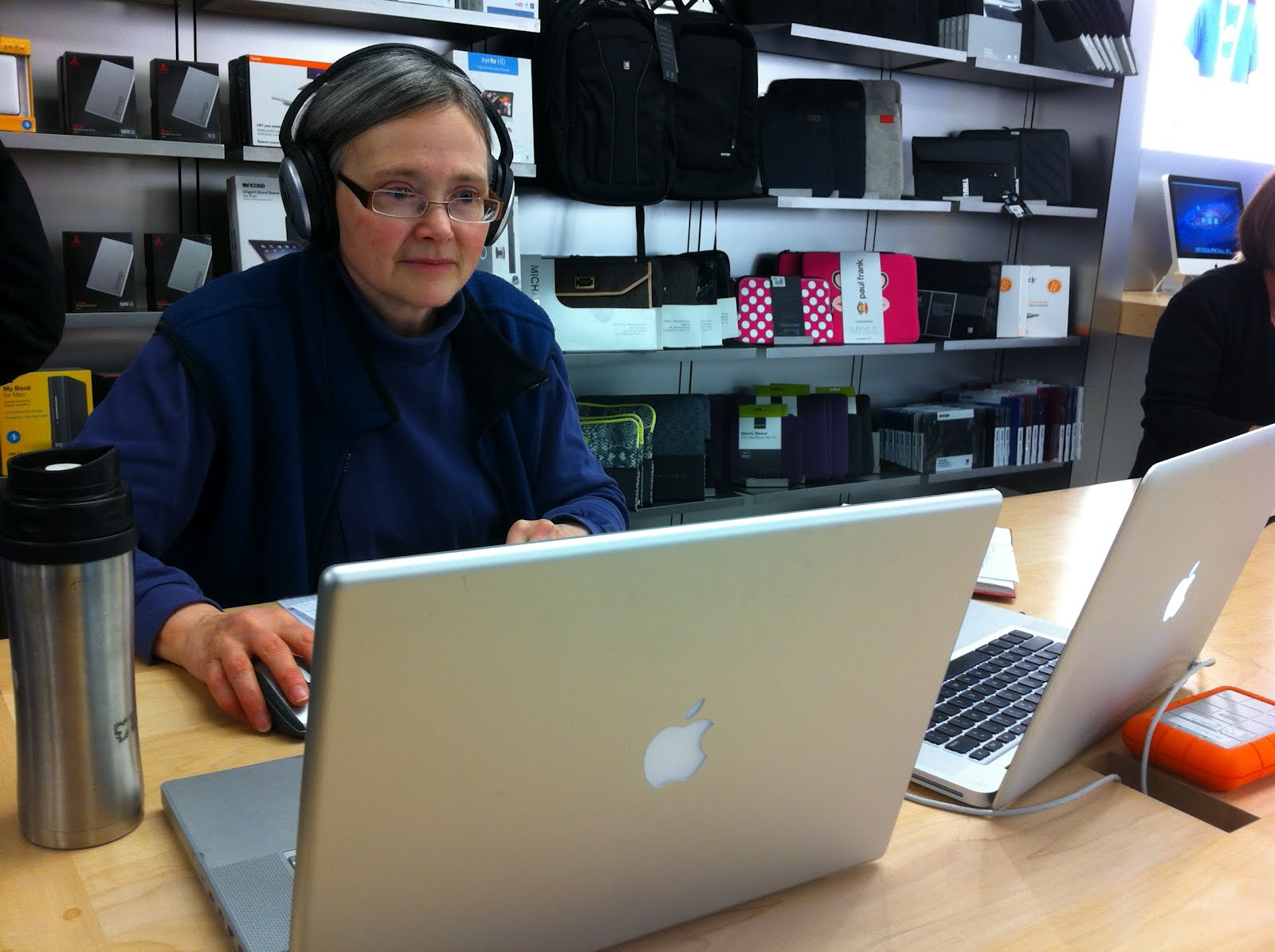
Personal project@ the Apple Store

Saturday, July 26, 2008

"Proust & the Squid": Reading and the Internet


Dr. Maryanne Wolf is concerned about the generation who has begun its reading life looking at text delivered to them, often from the Internet, via a computer screen rather than the printed page. As the Director of the Center for Reading and Language Research at Tufts University in Boston, she is doing high-tech research looking at the brain itself, to evaluate whether anecdotal reports about reduced attention spans and impatience with complexity are because our brains themselves are changing. Brains remain plastic throughout our lives. Are they physically adapting to a skimming style of reading? And if so, does this shift reduce our capacity to do what she calls "deep reading"?

She has written a book on this subject, called "Proust & the Squid: the Story and Science of the Reading Brain" (published in Canada by Harper Collins). Her work is also discussed in the Atlantic Monthly's "Is Google Making Us Stoopid?" which I discussed in my June 18 posting here: "An Article Worth Reading (All the Way Through)".

Her ideas seem to be getting mainstream attention. Last week, I heard an interview with her on CBC Radio One's popular "Sunday Edition". In the twenty minute conversation with Kevin Sylvester, she described how when she started writing "Proust and the Squid" her intention was to describe the "miraculous" deep reading process. When it comes to reading, she said, "the point of it all is to take what you read and then think and infer and gain insight. It is really beyond what a lot of people think about as 'just' reading. It's deep thinking .. and it takes place in one hundred to two hundred milliseconds. Over the eight years that she was writing the book "I had a completely different world on my hands". The effect of doing research using the vast amount of data streaming in from the Internet was resulting in a "skimming" reading style. "I was really beginning to worry that we were losing what we have. That it was trickling through our fingers ... not the older reader, but all that the younger reader was not necessarily going to do if their formation for reading was in the more superficial mode that is too often the case with the 'screen' kind of reading... By the end of the book I was filled with questions about what we don't know, and what we really need to be vigilant and do some very good and very sophisticated research on. What does that child who has really learned how to read as a 'screen reader'. What is the difference between that reader, and you, Kevin, who comes to the screen with a well-formed, critical, inferential reading kind of a mind?

"So I'm questioning whether the formation is going to lead us to have children who don't have the same kind of intrinsic 'pause button' that you and I have when we read and we know we have to go under the surface; don't assume anything; want to fill in the blanks; want to go back and check. There's a real critical -- and I use a term by a poet -- 'quality of attention' that we bring to reading because that's how we were formed. What I want to do is ... do research .. and see whether or not the strength of comprehension processes is altered... Reading is not natural in the sense that there is a genetic code that says it has to go this way. The Chinese reader is different from an English reader... [who]... is just a little bit different from a French reader ... So we certainly know we can form a different circuit. So my question and my concern ... is that we may be, without intention, giving rise to children who are more superficial and less analytical than you and I."

Her opinions have brought resistance. In her conversation she makes it clear that she, as a neural scientist who uses sophisticated technological tools to study the brain, is not a Luddite. Nor is she alone. She points to where the National Endowment for the Arts, using a different research basis is "coming to similar concerns" in their publication "To Read or Not To Read".

How to start addressing her concerns? She asks for "quality research" on this topic. And "close scrutiny" to "phasing-in technology... so before we know our answer, we won't have lost our kids. It's too important not to raise these concerns, even though I don't have the evidence. Because we have a lot of kids out there who are being shaped every single day of the year in ways that I think we've lost control over."

Tuesday, July 08, 2008

A reader recalls asking "What is a computer?"


"My father worked at the National Research Council and he used to tell me about the computers that he worked with and how large they were. At the time, they took up whole rooms and the computer cards that we used at church to make Christmas wreaths, always looked so strange with all those holes poked in them.

In the late 70's, I worked in a medical laboratory in Ottawa. At the time everything was written by hand or we used typewriters. The medical requisitions were all handcoded for billing but then we had a team that came in to implement the transition from paper to computer.

I remember being told that the computer would tell you by a beep if you made an incorrect entry. That "thing" beeped all the time. I refused to learn how to use it, I couldn't handle the rejection of a computer beeping. From that day forward, I decided to never get a job where I had to use a computer. Forget that. No way.

Kids do change your life. Looking back, I should have known that I was being set up by my parents when they brought over a computer for the kids. You know the kind, that took the big floppy disks and the CPU was a big thing that sat on the desk. Games, if you have a phobia working with computers, learn how to play children's games. That way you get used to a cursor and how to navigate the mouse. But these games were in DOS, before the mouse and Word.
Still, we spent many a night as a family with young kids, trying to figure out who could go to the highest level during Crystal Caves, my how I miss that game.

Well, eventually, I had to learn how to use wordperfect, as I was too daunted to try Microsoft Word, and eventually I had to learn how to use Word. Even though sometimes the computers still beep at me, I am now considered as the "computer wiz" where I work and I love computers."

Wednesday, June 18, 2008

An article worth reading (all the way through)


My friend Louse pointed me towards "Is Google Making Us Stoopid? What the Internet is doing to our brains" in the July/August issue of the Atlantic Monthly. Since I read it voraciously, I have mentioned the title to a couple of friends. Each had a strong response, but in opposite directions. One friend nodded vigorously, while the other rolled his eyes. The author, Nicholas Carr, is ready to acknowledge that "maybe I'm just a worrywart ... Perhaps those who dismiss critics of the Internet as Luddites or nostalgists will be proved correct, and from our hyperactive, data-stoked minds will spring a golden age of intellectual discovery and universal wisdom." He goes on, however, to express his concern that "as we come to rely on computers to mediate our understanding of the world, it is our own intelligence that flattens into artificial intelligence".

His starting point is his own shrinking attention span while reading, and a growing similar concern being expressed by others who also do most of their reading and research online. He cites both anecdotal and research evidence, as well as theorists like Marshall McLuhan, to support his theory that "What the Net seems to be doing is chipping away my capacity for concentration and contemplation. My mind now expects to take in information the way the Net distributes it: in a swiftly moving stream of particles. Once I was a scuba diver in the sea of words. Now I zip along the surface like a guy on a Jet Ski." Pointing out that "even the adult mind is 'very plastic''', he uses the example of how, after the philosopher, Nietzsche, switched from handwriting to using a typewriter, he observed that "our writing equipment takes part in the forming of our thoughts". Not for the better, apparently. Carr quotes a scholar who observed that "Nietzsche's prose 'changed from arguments to aphorisms, from thoughts to puns, from rhetoric to telegram style".

Carr quotes Larry Page, one of the founders of Google: "For us, working on search is a way to work on artificial intelligence". But Carr suggests that the Internet has re-introduced on a cognitive level the "maximum speed, maximum efficiency, maximum output" ethic which, in a manufacturing setting, produced the assembly line "industrial choreography" which many found demeaning and dehumanizing. "In Google's world, the world we enter when we go online, there's little place for the fuzziness of contemplation. Ambiguity is not an opening for insight but a bug to be fixed. The human brain is just an outdated computer that needs a faster processor and a bigger hard drive."

Even Carr confesses he doesn't read more than three paragraphs of a blog, and I notice that I'm now moving into my fourth. So I had better stop here. But please don't stop with my digest of a thoughtful and thought-provoking article. In the spirit of "use it or lose it", pick up the magazine, find a summer park bench and give it the time and attention it deserves.

Wednesday, May 28, 2008

"Connections" Revisited


The above video "The Trigger Effect" is the first episode of the seminal BBC-TV series "Connections" created by James Burke in 1975, about technological change. In closing, Burke strikes the theme of his series with a quote "... Our modern world affects us all. If you understand something today, that means it must already be obsolete. Or to put it another way -- never have so many people understood so little about so much." He describes the series as "detective story" looking at selected inventions which acted as "triggers" because they stimulated the production of further inventions which cumulatively changed "the way things are".

My twenty-five year old son watches this series on YouTube in the same way as we used to read National Geographic together as a bedtime story. When I fired "Connections" up today, I too found it fascinating. For me it is a COABC nexus that supports my growing conviction about the trans-generational nature of the issues arising from the search for a balanced use of technology.

This series was first aired over thirty years ago - four years after I graduated with my first university degree, and seven years before my son was born. My son had heard about this series a few years ago, and had even priced the DVD's before he found the cost too high to request the set as a Christmas present from his dad and myself. He reports stumbling upon the series while surfing on YouTube and found this one-hour episode is now available for free.

I am intrigued. In this first show, Burke's jumping-off point is to ask the viewer to look around them where they are sitting, and to reflect upon how their lives would change if the technology around them disappeared. Then he uses re-enactments of the "technology traps" revealed by the 1965 New York City blackout to point out how dependent we are on using technologies that, as individuals, we don't understand sufficiently that we could replicate them. Over the course of one hour he brings in subjects which were, at the time, theoretical ... like the effects of climate change, water shortages and natural disasters that precipitate mass evacuations. Thirty years before Hurricane Katrina and the recent earthquakes in China, this mixture of cultural theory and history also predated the Internet. When Burke creates disturbing scenarios about the losses implicit in the disruption of networks, he is talking about electricity.

Both my son and myself enjoy the combination of well-presented and disturbing scenarios with inadvertent cultural artifacts -- like the passengers stubbing out their cigarettes as their airplane, Flight 911, approached the NYC landing strip at precisely the moment the lights went out. We also agree that the questions that James Burke posed now seem prescient, and are even more relevant today for both those who came of age before and after computers.

Wednesday, May 07, 2008

Looking for the shift key


"Shift happens". That is the theme of the above 8-minute slide show, "Did You Know 2.0", about the pace of technological change. Aimed at American parents, educators and legislators, it makes a strong point that, in terms of globalization, we do ourselves and our children a favour by facing the fact that "we live in an exponential world".

I sent my April 17 article called "Snail mail in a post-fax world" to my ex-boss, who is featured there in my story of how, thirty years ago, I resisted his early adoption of the new fax technology. He currently teaches a course where he stresses "embracing technology", and kicks off his class with the above video.

I found myself watching it with double vision. As a parent, I am cheering my tech-savvy son on. But personally, I look at these daunting statistics from the other side of the digital divide. The video quotes Albert Einstein: "We can't solve problems by using the same kind of thinking we used when we created them." On a cognitive level, I can see the big picture. But on an experiential level, I feel the same sort of isolation that I imagine is felt by parents who have immigrated into a culture with a different language. They moved out of their own comfort zone to give their children more advantages, but find themselves coping with communication barriers that impede their own daily life. One person described her experience of rapid technical change in terms of the experience of leaving your mother tongue behind -- with the added dimension, for her, that she had not chosen to leave home.

In my city, some newcomer neighbourhoods have bilingual street signs, just to help people without strong English skills to find their way around. I hope to be able to use this blog as a space to provide similar non-judgemental bridges for those who came of age before computers -- people I refer to as "COABC's". It seems to me that there are dilemmas being faced, even by those of us who are trying to "be part of the solution", around the new learnings implicit in retooling our skills. Many are ashamed to admit to fatigue, conflicting time priorities, lack of access, and different learning styles. In another posting here, for example, I direct parents and teachers to the British site BT Digital Champions, which gives children tools to teach digital skills to their grandparents. Shift does indeed happen. But a child grows in compassion at the same time as their granny grows in skills, when they sit together at a computer locating that key.

Sunday, May 04, 2008

The "unplugged movement"- a quick blog survey

This morning, now that Shutdown Day is over, I find that their site is still not responding. Hmmmm... so I decided to look around at blog commentary about the "unplugged movement" which is related to the theme of yesterday's event. On the Reuters site I found an article called"Texting While Driving? Time to Unplug" with the subtitle "A grass roots movement has tech geeks wresting back control of their lives". Also I checked out a posting by Robert Bruce called "27 Thoughts on Blogging for the Artist", and another called"52 nights unplugged" which advocates "taking one night a week away from the digital pacifier". There is also one on the MSNBC News Site "Is there such thing as being too connected?" subtitled "The unwired think so. And they are not all sticks-in-the-mud."

The fact that all the above blogs are written by people who came of age AFTER computers is very interesting to me. This year, as I have been talking a lot about the theme of this blog in class, I found to my surprise that I was wrong in my assumption that my concerns are necessarily an age-related thing. A classmate, Genevieve Cloutier, interviewed me from a broader perspective for her documentary course, and we plan to do a more extended piece together about it over the summer. I have embedded her 5 1/2 minute YouTube video into my April 4 article "Making friends with my shadow." In future postings I'll be looking more into the subject here. But not today. I've organized a picnic for my family members who came to my grad, so the rest of today will be my own "digital day off".

Saturday, May 03, 2008

Please turn off this computer! Today is Shutdown Day

May 3 is a global event which is the "buy nothing day" of computers. The intention is to make people aware of how much of their best time and energy is being spent hunched over a keyboard. Sometimes you can't avoid having to be there -- in fact, if you are reading this at the kiosk at the opening night of the Emily Carr Undergrad Exhibition, 2008, I'm here at a computer myself! This one has been set to run 24/7 for the week of the show, so there IS no way to power down. If you look around right now, you will see me standing here hoping to have a conversation with you about my project, which is this blog. I'm the one dressed in black with the glasses.

But if you are at home, please bookmark this blog and come back tomorrow. Needless to say, today the website itself has been turned off. But come midnight, you could check it out to see reports coming of the many people who participated in the event by joining flashmobs being held around the world. Last year, according to reports, most people spent the 24 hours off from their computer having sex. This year, many will be doing the same, but it is nice to have an alternate. A flashmob gives the opportunity is go out and play with other people with a similar intention to risk taking the time to see how it feels to be out in a world unmediated by a computer screen. Last year I was out writing cherry-blossom haikus, as you can see in my video "Shutdown Day--One Year After" in the April 27 posting below.


2013 Update: Here is a Wikipedia article on Shutdown Day, which ended as an annual event in 2009. 

Friday, May 02, 2008

This blog is my art school graduation project


Tomorrow I graduate from Emily Carr Institute of Art + Design, in Vancouver, Canada with a Bachelor of Media Arts, and I will be receiving the Governor General's Silver Medal for the best marks in the class. Our graduation project is meant to represent what we currently see as our core creative work, and after much thought, I decided that this blog best represents what I see myself doing as an artist for the near future. It gives me an opportunity to self-publish my own writing and video work, as well as to feature other videos and websites which I think are relevant to the themes I explore here.

Like any artist, I will be trying to represent my own core concerns in a way that resonates for other people. Right now, for me, that concern is about how to have a balanced response to rapid technical change. I came back to school in my mid-fifties, and this gave me a chance to see the relevance of my own work in the context of other art that is being done now. At about the mid-point of my studies I switched to a department where I could learn how to use electronic tools like digital photography and video. I also started putting my work for public view via the Internet, rather than through the more traditional gallery system. As I am about to graduate, I am glad that I have skills and experience which give me the tools and credibility to be taken seriously, as I comment upon the pros and cons of those very tools.

There is a bit of "deja vu" operating here. In my first round as an artist, in my twenties, I worked in what is now called "traditional media" - doing drawings and sculpture. But by the time I was thirty, in the early 1980's, I started to respond to what I called "the writing on the wall". I was part of a group of artists who started an artist run centre called "Toronto Community Videotex" to work together to develop skills to create content for the precursor to the Internet. I am delighted that this organization, now known as InterAccess Electronic Media Arts Centre, has not only survived to celebrate it's 25th Anniversary this year, but is a vibrant part of Toronto's art community.

When we fast forward to 1999, and my return to electronic media, the sad reality was that I was twenty-five years older too, and had lost my position as an "early adopter". But I had become intrigued by the City of Vancouver's Millennium Project Portrait V2K, where you can find my story if you search for "Strider". I loved the concept that a website gave them the capacity to publish every story and photo that citizens would upload, and got my high-school son to help me to scan and upload my story and photo. I was lucky that I scored on my first try. My story became one of the featured ones, silkscreened on a huge banner in the project's year-long exhibition at the Vancouver Museum.

Positive experiences like that made me open to exploring new media when I returned to art school. But initially I felt a lot of shame as I sat in the computer lab, surrounded by students who seemed to have been working with computers since the day they were born. I was committing myself to spending a lot of time in a very steep learning curve, often feeling awkward and stupid. Conversations with people who were mid-life and older made me realize that I was not alone in feeling this way. So the exploration of this "shadow" is currently my central creative theme. For now, what interests me most is an examination of the impact on daily life that results from lack of skills, access -- or interest -- in electronic tools like computers, email, and cell phones. On a broader level, I hope that readers of this blog will also find positive suggestions for using the Internet itself to facilitate a zestier engagement in the face-to-face world.